Category Archives: TEACHER TRAINING

The Eight Limbs of Yoga (Part 7 – Dhyana, W/Video)

The Eight Limbs of Yoga (Part 7 – Dhyana)Dhyana is a Sanskrit word which means to meditate, derived from the verbal root dhyai, Dhyana  it is the most common designation for both the meditative state of consciousness and the yogic techniques by which it is attained.

Dhyana is the seventh of Patanjali’s “Eight Limbs” of Raja Yoga (or classical yoga). Patanjali describes Dhyana as the repeated continuation, or uninterrupted stream of that one point of focus (Dharana) is called absorption in meditation (dhyana), and is the seventh of the eight steps (Yoga-Sutras 3.2).

There are two distinct stages that precede the practice of Dhyana. The first leads to sense withdrawal (Pratyahara), the second to concentration (Dharana), and finally, after these first two stages have been achieved, the yogi or student is prepared for the practice of true meditation (Dhyana).

Without such prior preparation, the efforts to concentrate the mind, often leads only to an inner and frustrating battle. The vrittis of chitta (fluctuations of the “mind stuff” or constant chatter of the mind) leads people to say they cannot meditate, and they intend to learn to meditate later. But the key is not to merely put off meditation practice until some future time, which never seems to come. Rather, the truth of the matter is that preparation is needed. With preparation, concentration and meditation arise naturally. Without the preparation, little or nothing of value happens.

The student is instructed to always to begin with concentration (Dharana), and then proceed to meditation (Dhyana), which finds fruition in Samadhi. This triple process is called samyama. During this process the yogi (or student) may become aware of higher powers (Siddhis) and become captivated by them, but Patanjali warns they are obstacles to the full or higher samādhi. Only by non-attachment to even these things, however great they may seem, may the seeds of bondage be destroyed, and independence or freedom attained.

In summary: Dhyana is the unbroken stream of concentration, where little to no “sense of self” remains. At this stage, it becomes increasingly more difficult to use words and reasoning (thoughts), or the conscious mind to describe these inner experiences of yoga. After all, the state of meditation, by its very nature transcends our material human experience and everything that is related to it. Meditation (Dhyana), is concentration (Dharana) taken to “perfection”; in other words, the meditative state is the natural consequence of “perfect concentration”. So it is by prolonged concentration, that produces this “spontaneous”, “free-flowing” meditative state, where nothing except the object of concentration fills the mind’s space; and where the observer and the observed merge into one.

If you are unfamiliar with meditation the following video (Andy Puddicombe: All it takes is 10 mindful minutes) may be helpful…

Related article, click on: The Eight Limbs of Yoga (Part 6 – Dharana)

Check back soon for “The Eight Limbs of Yoga (Part 8 – Samadhi)”

The Eight Limbs of Yoga (Part 6 –Dharana)

The Eight Limbs of Yoga (Part 6 –Dharana)Dharana is a Sanskrit word which means immovable concentration of the mind (or that which gives stability”) from the root Dhar, which means to “bind together”, “to make stable”. Dharanais  the willful act of concentration of the mind.
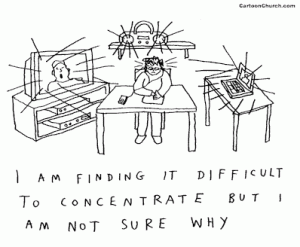
Dharana is the sixth of Patanjali’s “Eight Limbs” of Raja Yoga (or classical yoga). Patanjali describes Dharana thusly: “When the pure mind is kept focused in the desired desa (region) by the seeker, it is called Dharana.”

Patanjali considered Dharana, Dhyana and Samadhi to be the last three steps in his eightfold path and that all three aspects considered together are collectively termed “Samyama” (Control). We should also keep in mind, that Dharana, Dhyana and Samadhi are progressively advancing stages of concentration. The highest stage of mental concentration described by the Western psychologists is similar to the description of Dharana which Patanjali designated as the initial or primary stage of concentration, with Dhyana as the intermediate and Samadhi as the final or highest stage.

Characteristically there is no dividing line in between any of these three stages. When certain progress is made in the practice of Dharana, Dhyana stage is automatically entered into and so on with the progress through Dharana stage, the student or yogi automatically enters in the Samadhi stage. The three stages are said to mingle into each other as easily as three colors are mixed together on an artists palate.

In this article we will consider only the first stage; Dharana, (Dhyana and Samadhi to be considered in upcoming articles).

The Eight Limbs of Yoga (Part 6 –Dharana)

In practicing Dharana, the student creates a condition conducive for the mind to focus its attention in one direction or on one object rather than of radiating out in a multitude of different directions. As concentration deepens, the focus on a single chosen point becomes more intense and the other preoccupations of the mind cease to exist.

The objective in Dharana is to steady the mind by focusing its attention efficiently on one subject or point of experience. Concentrate on any object (within the body or outside) that is appealing, selecting any object that’s pleasant and brings in concentration of the mind easily. Now if the student chooses to focus on their inner energy flow, they can directly experience the physical and mental blocks and imbalances that remain in their system, in other words, the obstacles to their progress becomes obvious.

Once established, this ability to withdraw the mind from all its “fluctuations” (or modifications), and concentrate on a single point produces psychological health and personal integration and should not be considered an escape from reality, but instead, a positive movement towards the realization of the true nature of the Self. This prepares the student for the next stage (Dhyana), where concentration becomes meditation and the one meditating becomes one with the object of meditation.

In summary: The practice of Pratyahara creates the setting for Dharana or concentration. When one is relieved of outside distractions, they can now deal with the distractions of the mind itself. In the practice of concentration, which precedes meditation, a student can learn how to slow down the thinking process by concentrating on a single mental object. The goal is to become aware of nothing except the object of concentration, it can be a candle flame, a flower, a mantra you repeat to yourself, a specific energetic center in the body, a picture of a guru or an image of a deity, any of the chakras can also be used as a focal point for concentration. The ultimate purpose of Dharana is to train the mind over time by eliminating all the extra, unnecessary superfluous thought. Extended periods of concentration will naturally lead to meditation (Dhyana).

The Eight Limbs of Yoga (Part 6 –Dharana)

Related article, click on: The Eight Limbs of Yoga (Part 5 – Pratyahara)

Check back soon for “The Eight Limbs of Yoga (Part 7 –Dhyana)”

The Eight Limbs of Yoga (Part 5 –Pratyahara)

The Eight Limbs of Yoga (Part 5 –Pratyahara)Pratyahara is derived from two Sanskrit words: prati and ahara, with ahara meaning anything taken into ourselves, and prati, a preposition meaning away or against. Pratyahara means literally “control of ahara,” or “gaining mastery over external influences.” It is compared to a turtle withdrawing its limbs into its shell; the turtle’s shell is the mind and the senses are the limbs. The term is usually translated as “withdrawal from the senses,” but much more is implied.

Pratyahara is the fifth of Patanjali’s “Eight Limbs” of Raja Yoga (or classical yoga).

In yogic philosophy there are three levels of ahara, or food. The first is physical food that brings in the five elements necessary to nourish the body. The second is impressions, which bring in the subtle substances necessary to nourish the mind; the sensations of sound, touch, sight, taste, and smell. The third level of ahara is our associations, the people we hold at heart level who serve to nourish the soul and affect us with the gunas of sattva, rajas, and tamas.

Pratyahara is twofold. It involves withdrawal from wrong food, wrong impressions and wrong associations, while simultaneously opening up to right food, right impressions and right associations. We cannot control our mental impressions without right diet and right relationship, but pratyahara’s primary importance lies in control of sensory impressions which frees the mind to move within, preparing the student for the next stage in the Eight Limbs, “Dharana” (Concentration).

When we withdraw our awareness from negative impressions, pratyahara strengthens our mind’s powers of immunity. Just like a healthy body resists toxins and pathogens, a healthy mind can ward off the negative sensory influences around it. If you are easily disturbed by noise and/or turmoil in the environment around you; practice pratyahara, for without it, you will not be able to concentrate or meditate properly.

Pratyahara and the prevention of disease: The Eight Limbs of Yoga (Part 5 –Pratyahara)

Ayurveda recognizes that the inappropriate use of the senses is one of the main causes of disease. Mental disease is directly connected with the intake of unwholesome impressions. Therefore pratyahara is an effective practice for treating all mental disorders. Additionally, it is very helpful in treating nervous system disorders, especially those that arise through hyperactivity. Most of the time we overly express our emotions and this drains us of tremendous amounts of energy. Pratyahara teaches us to hold our energy within us and not disperse it unnecessarily. When conserved this energy can be drawn upon for creative, spiritual or healing purposes as needed and can provide the extra power we may need to accomplish the things that are really important to us.

Physical (bodily) disease mainly arises from taking in unwholesome food. Pratyahara affords us control of the senses so that we do not crave wrong food. When the senses are controlled, everything is controlled and no wrong or artificial cravings can arise. This is why Ayurveda emphasizes proper use of the senses as one of the most important factors for wholesome living, disease prevention and maintaining optimal health.

The Eight Limbs of Yoga (Part 5 –Pratyahara)

Related article, click on: The Eight Limbs of Yoga (Part 4 – Pranayama)

Check back soon for “The Eight Limbs of Yoga (Part 6 –Dharana)”

The Eight Limbs of Yoga (Part 4 – Pranayama)

The Eight Limbs of Yoga (Part 4 – Pranayama)

Pranayama is a Sanskrit word which means “restraint of the Prana or breath”. The word is actually composed of two words; Pran, meaning life force, or vital energy, particularly referring to the breath, and “ayama”, which means to control, suspend or restrain. It is generally understood as controlling the life force (Prana). When used as a technical term in Yoga, it is often translated more specifically as a variety of methods and techniques used for “breath control”.

Pranayama is the forth of Patanjali’s “Eight Limbs” of Raja Yoga (or classical yoga).

Pranayama is an exact science. “Tasmin Sati Svasa prasvasayorgativicchedah Pranayamah” Translated as “Regulation of breath or the control of Prana is the stoppage of inhalation and exhalation, which follows after securing that steadiness of posture or seat, Asana.” This is Pranayama as defined in Patanjali Yoga Sutras (Raja Yoga), Chapter II-49.

Raja Yoga, in theory, tells us that prana is animating the mind. Similar to the wind giving motion of the leaves, prana creates the motion of the mind, giving rise to the vrittis (fluctuations of the “mind stuff”). Air is considered to be the primary physical medium of prana and breathing is most direct method to gain control over the prana. When meditating, the practitioner should calm down his breath until it is very shallow and even, keeping in mind that on the subtle plane the Prana that they are breathing is much more than just atmospheric air, it carries the life force itself.

The Eight Limbs of Yoga (Part 4 – Pranayama)By controlling the act of breathing the student can efficiently and effectively control the various motions in the body and the different nerve currents that are animating the body. When practiced properly, one can easily and quickly gain control over body and mind through Pranayama, developing character and consciously harmonizing the individual’s life with the cosmic or Divine life.

The breath, when directed by concentrated thought and brought under the control of the will, becomes a vitalizing, regenerating force which you can direct, using it consciously for self-development, for healing diseases and ailments in your system and for healing others plus many other useful purposes. Research has shown that Pranayama techniques are beneficial in treating a range of stress related disorders, improving autonomic functions, relieving symptoms of asthma, and reducing signs of oxidative stress. Yogis report that the regular practice of Pranayama develops a steady mind, strong will-power, and sound judgment; they also claim that sustained Pranayama practice extends life and enhances perception.

Pranayama should not be practiced in isolation, but instead be part of an overall practice that includes the other limbs of Patanjali’s Raja Yoga teachings, especially the first three Yama, Niyama, and Asana which are preliminary.

*Cautionary note: Pranayama, when not practiced properly may be harmful, even dangerous. Certified yoga teachers recommend that Pranayama be practiced with proper instruction and care, and that advanced Pranayama techniques should only be practiced under the guidance of a qualified teacher. Therefore, it is recommended that if you wish to begin practicing Pranayama, you first speak with Rae – so please visit her “Contact” page.

Related article, click on: The Eight Limbs of Yoga (Part 3 – Asana)

Check back soon for “The Eight Limbs of Yoga (Part 5 –Pratyahara)”

The Eight Limbs of Yoga (Part 3 – Asana)

Asana is a Sanskrit word literally translated as “to sit”, although, generally speaking, asana refers to an assumed body position, pose or posture. Asana is the third of Patanjali’s “Eight Limbs” of Raja Yoga (or classical yoga).

Yoga asana can be static or dynamic. Many asanas look static from the outside, but they are dynamic by their very essence. When the yogi or student uses the body to perform any pose, this requires engaging their muscles to assume and maintain that form. So therefore, all asanas involve muscle work and stretching, and are by definition, not static because any tension is related to the dynamic process and this holds true for all bodies. There are of course, exceptions to the rule, being Shavasana, the posture of “conscious self-shutdown”, and Padmasana the “perfect meditating posture”, done with the body fully balanced and relaxed in the sitting cross-legged position. Asana when intended as a dynamic set of movements between poses generally refers to the transfer of a student’s posture from one stage to another, or even to a completely different pose.

Basic categories of Asana are…

  • Seated (with twists)
  • Standing
  • Core
  • Backbends
  • Arm Balances
  • Foreword bends
  • Inversions
  • Restorative
  • Meditation
  • Pranayama
  • Mudra & Bandha

You will find there are many varieties and techniques of actual asana practice available and plenty of opinions about content, but most teachers start by having their students focus on structural alignment, methods of breathing during the practice, and increasing awareness.

Asana simultaneously produces both contraction and expansion, massaging the muscles, connective tissue and the skin, keeping them moist and elastic. Joints are moved through their complete range of motion safely, although some precautions and contra-indications may be given by a responsible Yoga teacher since not all body types have the same immediate capacity. Because correct alignment is emphasized, the stretching muscles will move along certain planes, increasing blood flow to specific areas without putting a strain on other body systems.

Asana has many proven health benefits and continued personal experience affirms the effectiveness of its practice, though the benefits will vary with the individual. Asana does not just affect skeletal muscles and their associated joints, it also has added value for the body’s circulatory, lymphatic and respiratory systems. Additionally, it is designed to produce health giving affects on connective tissue, the nervous system, and the various organs of the body.

*In summary: While asana practice is a set of postures designed to enhance health and harmonize us with our inner consciousness, according to Maharshi Patanjali in his Yoga Sutras, the original intent and purpose of asana is the attainment of a sustained and comfortable sitting posture to facilitate meditation. To achieve this asanas help in balancing and harmonizing the basic structure of the human body which is why, if performed regularly and consistently, they have a wide range of therapeutic benefits, both physical and mental.

Related article, click on: The Eight Limbs of Yoga (Part 2 – Niyama)

Check back soon for “The Eight Limbs of Yoga (Part 4 – Pranayama)”

The Eight Limbs of Yoga (Part 2 – Niyama)

Niyama – In Sanskrit, means “observance,” or religious observance (aka, the 5 dos of Yoga)

Niyama is the second step in the Eightfold Path (the 8 Limbs) of Patanjali’s Yoga Sutras and contains the five internal practices of Niyama. These observances outline the five principles which are control (or regulate) the organs of perception; the eyes, the ears, the nose, the tongue and the skin. As these sense organs are brought under our conscious control, it will reduce attachments and help to free the mind of its clutter.

Niyama extends the ethical codes of conduct described in Patanjali’s first limb (the Yamas) to the yoga student or practicing yogi’s internal environment, i.e.; the body, mind and spirit. The practice of Niyama helps to maintain a positive environment in which to grow, giving us the self-discipline and inner-strength required to insure continued progress along the path of yoga.

Patanjali considered all five of the Niyamas as interesting tools for self assessment and personal growth. Applying these concepts, can shift a situation; so often our thoughts and attitudes dictate out past experience, and these practical observances help us to see where we actually are and improve upon that. The Niyamas refer to a positive attitude that we may adopt regarding ourselves, as they empower us to create a code for living purposefully and meaningfully.

Cultivating Niyamas allows you to cultivate discipline and responsibility. They are ultimately designed to help purify your body, mind and emotions.

Niyama: The Five Dos of Yoga:

  1. Shaucha (purity, cleanliness)
  2. Samtosha (contentment)
  3. Tapas (austerity, asceticism)
  4. Svadhyaya (self-study, spiritual-study)
  5. Ishvara Pranidhana (devotion, worship)

As we progress towards living a more balanced life, the qualities presented in the Niyamas will tend to naturally arise in us. In reality they may be viewed as evolutionary qualities that are a reflection of our connection with universal spirit. As such the Niyamas can be considered milestones along the path of our spiritual growth.

Related article, click on: The Eight Limbs of Yoga (Part 1 – Yama)

Check back soon for “The Eight Limbs of Yoga (Part 3 – Asana)”

The Eight Limbs of Yoga (Part 1 – Yama)

Yama – Self-restraint, self-control and discipline (aka, the 5 don’ts of Yoga)

Yama is the foundation of yoga.  It is the first step in the Eightfold Path (the 8 Limbs) of Patanjali’s Yoga Sutras. Yama tells us what to avoid doing because it would bring harm to the individual and others.  The observance and practice of yama disciplines the five organs of action; the arms, the legs, the mouth, the organs of regeneration, and the organs of excretion. It is quite natural for the organs of action to control the organs of perception and of the mind. Whenever the mind intends to bring harm to something and the organs of action refuse, no harm will be done. Therefore, Yama is regarded as the foundation or root of the tree of yoga.

Patanjali considered the Yamas to be great, mighty and universal vows. He instructs us that they need to be practiced on all aspects of our being (meaning; actions, words, and thoughts) and that they are not confined to class, race, gender, time or place.

Yama outlines the moral, ethical and societal guidelines for students of yoga and the practicing yogi. These guidelines are all expressed in a scientific and positive manner, thus becoming dynamic descriptions of how a yogi behaves and relates to the world when fully immersed in the experiential unitive state of yoga, called Samadhi. For those of us who have yet to achieve such a pure state, the Yamas are still highly appropriate and valued guides to help us consciously lead a more moral, ethical and honest life.

Yama: The Five Don’ts of Yoga:

  1. Ahimsa – Non-violence
  2. Satya – Non-lying (truthfulness)
  3. Asteya – Non-stealing
  4. Brahmacharya – Continence (celibacy)
  5. Aparigraha – Non-coveting

In a very practical sense, observing and practicing the Yamas eliminates, or at least reduces the accumulation of negative karma as well as preventing the draining of our energy caused by leading a false and/or unconscious life. When practicing the Yamas we’re promoting a healthier, holier and more peaceful life while simultaneously raising our awareness, strengthening our will and increasing our power of discernment. Engaging these practices is formidable task, although by doing so we fortify our character, improve our personal relationships, and further our progress on the spiritual path to the yogic union between the individual self and the universal self.

Related article, click on: Patanjali’s Eightfold Path (the 8 Limbs of Yoga)

Check back soon for “The Eight Limbs of Yoga (Part 2 – Niyama)”

Patanjali’s Eightfold Path (the 8 Limbs of Yoga)

In his classical yoga treatise, Raja Yoga, Patanjali ordered yama and niyama before asana and pranayama on the eightfold path. But most contemporary students learn asana first, and oftentimes they learn asana outside the context of the other essential limbs on the tree of yoga. If you teach hatha yoga in isolation or without reference to the other limbs, it can be difficult to integrate the teaching with traditional yoga philosophy and science. As said by Swami Gitananda Giri; “…Patanjali’s Ashtanga yoga is ‘no option yoga’. Simply performing asanas and pranayama without the higher aspects of yoga is fruitless”.

In his Yoga Sutras (Raja Yoga) Patanjali compiled 195 sutras (concise aphorisms) that are essentially an ethical blueprint for living a moral life and incorporating the science and practice of yoga into that life. In these Yoga Sutras, the eightfold path is collectively called “ashtanga” in Sanskrit, which literally means “eight limbs” (ashta-eight, anga-limb). These eight steps serve as basic guidelines on how to live a meaningful and purposeful life. They function as a prescription for moral and ethical conduct through self-discipline, directing attention toward one’s health and helping the student to recognize and acknowledge the spiritual aspects of their own nature.

These eight limbs of Patanjali intertwine like the branches of a tree in the forest. They aren’t commandments (although they sometimes sound like them), laws, or hard and fast rules. They are simply Patanjali’s suggestions for living a better life through yoga.

In future articles I will go into details of each individual limb, including each one of the five Yamas and Niyamas. Here’s a list of the eight limbs of Patanjali.

  1. Yama (5)
  2. Niyama (5)
  3. Asana
  4. Pranayama
  5. Pratyahara
  6. Dharana
  7. Dhyana
  8. Samadhi

Stay tuned – more to come…

5 Positive Lifestyle Changes for the New Year (Part 3)

Are you in a rut? Are you feeling like you’re losing your “touch”? Is complacency becoming the norm? Maybe what you need are some basic lifestyle changes. In the coming days we will review five suggestions for the New Year to help improve your health and overall wellbeing – helpful advice that may also initiate a sense of self-renewal and give you more energy, which in turn will give you a whole new outlook on life.

To review part 1, click on: Go on a cleanse or detox diet.

To review part 2, click on: Improve your dietary choices

Here’s part 3…

3. Find a daily activity that insures you’re getting enough exercise.

Studies show that low to moderately intense activities can have some short and long-term benefits. If done daily, they may help lower your risk of heart disease. Activities such as pleasure walking, climbing stairs, gardening, yard work, moderate housework and dancing help, but ask yourself, is that enough? By engaging in more vigorous exercise, you can greatly improve the overall fitness of both the heart and lungs, which provides much more consistent benefits for lowering heart disease risk plus a host of other physical advantages such as better digestion, elimination of toxins, improved liver and kidney function and weight loss, to name a few.

Many people are now discovering (or rediscovering) the awesome benefits of regular, vigorous exercise; activities like swimming, brisk walking (or hiking), running, or working out at a gym or fitness center. These forms of exercise are generally called “aerobic,” meaning the body uses oxygen to produce the energy needed for the activity. An aerobic exercise will elevate your heartbeat (cardiovascular) and makes you sweat, and contrary to popular belief, Yoga IS an aerobic or cardiovascular exercise and can condition your heart and lungs if performed at the proper intensity for at least 20 minutes, 3-4 times a week. Ashtanga Yoga, Hot Yoga, Power Yoga are perfect examples.

So, you don’t have to train like a professional athlete or marathon runner to become more physically fit! Any activity that gets you moving around, gets you heart beating and causes you to break a sweat will work, and even if it’s done for just a few minutes each day it’s better than exercise at all. For sedentary or inactive people, the trick is getting started. Once started, exercising in the company of other like-minded people will keep you on track and motivated.


There are many benefits experienced by people who get regular physical activity, here’s a few…

Exercise helps you feel better because it:


  • gives you more energy
  • helps you cope with stress
  • improves your self esteem and self-image
  • increases your resistance to fatigue
  • counters anxiety and depression
  • enables you to relax and feel less tense
  • improves your ability to sleep more soundly
  • provides an easy way to share an activity and an opportunity to meet new friends


It helps you look better because it:


  • shapes & tones your muscles
  • burns off calories to help lose extra pounds or helps you maintain your desired weight
  • helps control your appetite
  • reduces the appearance of cellulite
  • improves your posture
  • Gives you a healthy glow (from increased circulation)

Additionally, aerobic or cardiovascular exercise fights the onset of age-related disease, lifts your spirits and sense of well-being, increases your lung capacity so you can take in more oxygen, boosts circulation to deliver nutrients to cells and skin, lowers inflammation, and, for many, is said to be the ultimate stress reducer.

Third Eye Meditation – Opening the 3rd Eye

Can you imagine what your life would have been like if you had kept your eyelids shut since you were born? Your eyes would have worked perfectly but yet your sense of vision would have gone to waste. Similarly, not opening your 3rd eye is keeping you in the dark in relation to enjoying the wonders and wisdom of your sense of mystic or spiritual sight.

This can be likened to putting shutters on a window and keeping them closed. No light comes in and those on the inside can only imagine the marvels of all that exists outside of those shutters. Unfortunately, this really leaves us in the dark about what is real, who our true Self is and what life is really all about.

While attending a secret, esoteric school in Egypt, Pythagoras was given the following technique…

“ATTENTION BETWEEN EYEBROWS, LET MIND BE BEFORE THOUGHT. LET FORM FILL WITH BREATH ESSENCE TO THE TOP OF THE HEAD AND THERE SHOWER AS LIGHT.”

Pythagoras then traveled with this technique to Greece, and consequently he became the fountainhead, the primary source of all mysticism in the West. He is recognized by many to be the father of mysticism in the West.

Attention between the eyebrows – although relatively simple, this technique is very deep. When we try to mentally comprehend this, modern physiology and scientific research, points out that between the two eyebrows is a gland which is the most mysterious part of the body. This gland, the pineal gland, is the third eye of the Tibetans; Shivanetra (the eye of the Shiva), of tantra. Between the two eyes there exists a third eye, but it is impotent, non-functioning. It’s there, it has the ability to function any moment, but it does not normally function on its own. You need to do something about it, you have to open it. It’s not blind; it is simply closed.

Now, some notes on the technique used to open the third eye…

Close your eyes, (or keep them half-open/half-closed) and look upward – not forcibly crossing your eyes, but instead, converging them slightly. Then focus both of your eyes just in the middle of the two eyebrows. Focus attention just in the middle, as if you are looking with your two eyes. Give your total attention to it. This is actually one of the simplest methods of being attentive. You cannot be attentive to any other part of the body quite as easily. This pineal gland absorbs attention like a sponge. If you give attention to it, both your eyes become mesmerized with the third eye. They become transfixed; they cannot move. The third eye catches attention; it’s like a magnet for attention. Traditions all over the world have used this method. It is simple because with a little effort in trying to be attentive, the pineal gland itself helps you; it is magnetic. Your attention is brought to it and then that attention is absorbed.

It is said in the ancient tantric scriptures that attention is food for the third eye. It is hungry; it has been hungry for your whole life. And once you pay attention to it, it becomes awake. It becomes alive! The food is given to it in the form of attention. And once you know that attention is food, attracted by the gland itself – then it is not a difficult thing. One has only to know the right point. The important thing is to bring your attention to that area. Don’t try forcibly to bring your eyes to a focus, but gaze mentally towards that point, and let the spiritual eye draw you into itself. Remember at all times keep your eyes relaxed and your brow smooth. When it becomes difficult to move them, then know you have found the right point.

Being focused on the third eye, suddenly you become a witness. Through the third eye you become the witness and you can see thoughts running through the mind like clouds in the sky or people passing on the street. While focused in the third eye, suddenly you can observe the very essence of breath, not just the breath, but the very essence of breath, which is prana.

Pythagoras’ sutra says, “Let form fill with breath essence to the top of the head…” And when you come to feel the “essence” of breathing (prana), just imagine that your head is filled with it, simply imagine that. No need for any effort. When you are focused on the third eye center and then imagine it filling all the space in your head, the “shower of light” happens, then and there – a shower of light falling down from the top of your head. This shower can recreate you; it can give you a new birth.

This 3rd eye meditation technique has the potential to throw the shutters wide open, as well as provide you with wings to transport you to the infinite, eternal, universal divine reality that is your inherent birthright.