Pranamaya Kosha is the second of the five Koshas (sheaths).
Pranamaya Kosha, is a Sanskrit term meaning “the sheath of energy”. Prana, in Sanskrit, means vital energy, Maya means composed of, Kosha means sheath. So, Pranamaya Kosha is the sheath of vital energy within each human being.
The Pranamaya Kosha is more subtle than the Annamaya Kosha (gross physical sheath). The whole of the physical body is pervaded by the Pranamaya sheath. The Pranamaya sheath contains the five Karma Indriyas (Vayus) or organs of action (brief summary below) and along with the mental and intellectual sheaths, forms the subtle body of Linga Sarira (the astral body).
The five Karma Indriyas (Vayus):
-
1. Prana: has an upward movement and is responsible for all things taken into the body (food, fluids, air, sensory inputs and mental impressions).
-
2. Apana: has a downward movement and is responsible for all forms of elimination and reproduction functions (stool and the urine, the expelling of semen, menstrual fluid and the fetus, and the elimination of carbon dioxide through the breath).
-
3. Udana: has an upward movement and is responsible for growth of the body (the ability to stand, speech, effort, enthusiasm and willpower).
-
4. Samana: has an inward movement (moving inward from the periphery, working in the gastrointestinal tract to digest food, in the lungs to process air, absorbing oxygen, and in the mind to homogenize and assimilate experiences; sensory, emotional and/or mental).
-
5. Vyana: moves from the center outward to the periphery. It governs circulation on all levels, moving food, water, blood and oxygen throughout the body, and keeping emotions and thoughts circulating in the mind. In doing this, Vyana assists all the other Pranas in their work.
In order for the first or outer Kosha (Annamaya) to function it needs to be energized and sustained by the vital Prana available via the Pranamaya Kosha, the energy sheath. If the energy sheath is absent the physical body will disintegrate and merge back into its five elements (earth, water, fire, air and ether). The Pranamaya Kosha can be viewed as being responsible for all the physiological functions in the body (breathing, blood circulation, digestion, heartbeat, all hormonal functions, communication between the brain and the cells of the body etc.).
The primary Yoga practice that is used to energize and vitalize the Pranamaya Kosha is Pranayama (control of the breath).
The Pranamaya Kosha is the vital force that produces the subtle vibrations related to breath, and which are the driving force behind the physical aspect of the senses and the operation of the physical body. It allows the invisible indweller, our true “Self” to be able to animate through the body in the external world. Ironically, at the same time, it allows the eternally still, silent center of consciousness to be mistakenly identified as the moving, visible physical body.
Vedanta philosophy instructs us that for both a healthy life and the proper practice of meditation, it is very useful, even essential that this level of our being be trained, regulated, and directed, so that it flows smoothly and easily.
The Pranamaya Koshasurvives the physical body, but only momentarily, for it is also transitory.
Stay tuned, coming up next will be: The Five Koshas (Part 3 – Manomaya Kosha: mind (mind-stuff) sheath.
 Samadhi is a Sanskrit word which is the state of consciousness induced by complete meditation, derived from the verbal roots “samā” (the state of total equilibrium) and “dhi” (of a detached intellect).
 Dhyana is a Sanskrit word which means to meditate, derived from the verbal root dhyai, Dhyana it is the most common designation for both the meditative state of consciousness and the yogic techniques by which it is attained.
 Dharana is a Sanskrit word which means immovable concentration of the mind (or that which gives stability”) from the root Dhar, which means to “bind together”, “to make stable”. Dharanais the willful act of concentration of the mind.


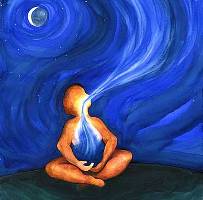 By controlling the act of breathing the student can efficiently and effectively control the various motions in the body and the different nerve currents that are animating the body. When practiced properly, one can easily and quickly gain control over body and mind through Pranayama, developing character and consciously harmonizing the individual’s life with the cosmic or Divine life.